
View Active Lots
We've combined car search, purchase, payment, and delivery into a single system. From bidding to delivery to your country everything is under control in one dashboard.
Find out why buying through Stat.VIN is profitable
Find out more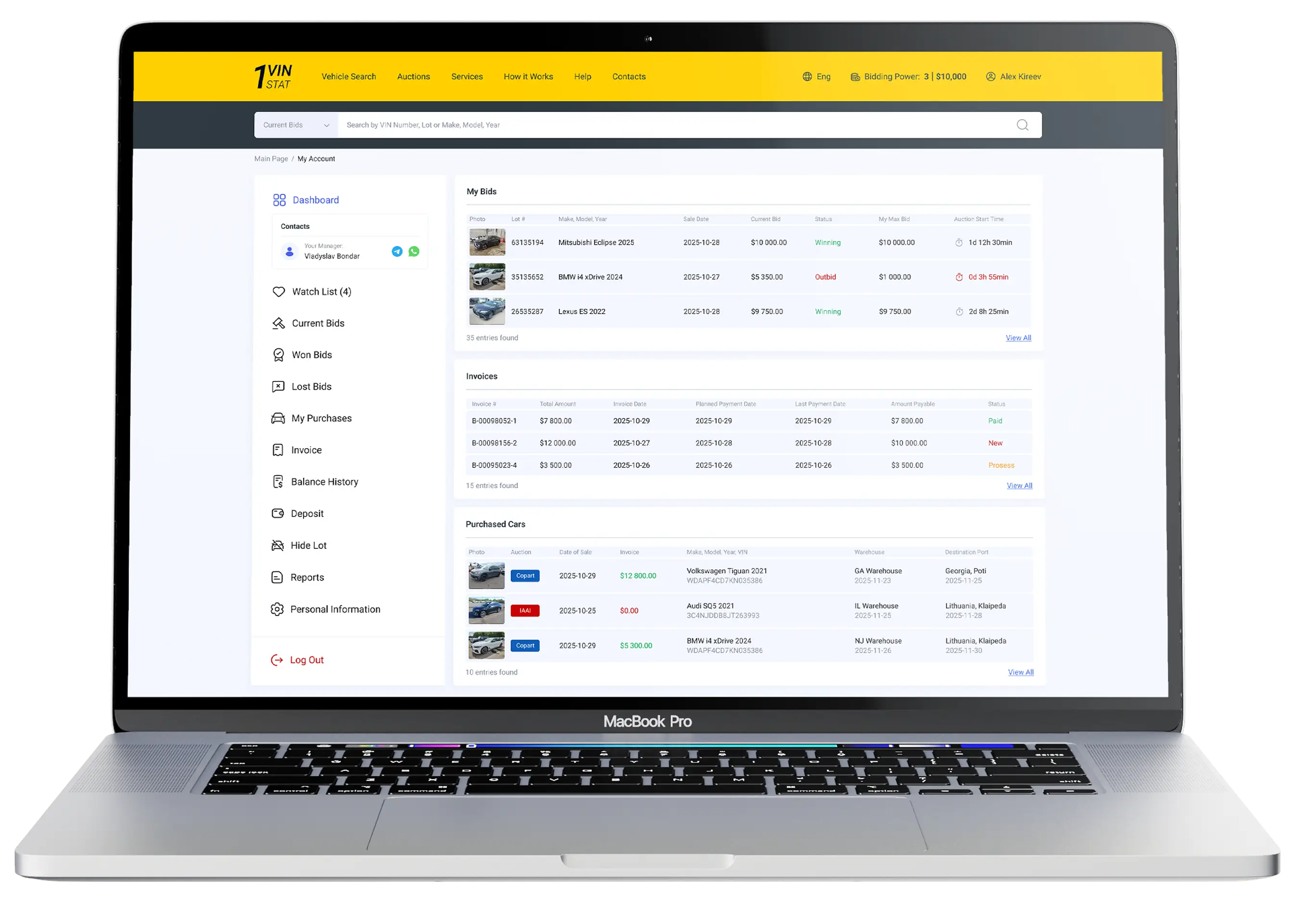
Find a Car by Brand
Open the Auction History for your chosen brand, find out how much similar cars have sold for, and compare prices before bidding.


Find car by State
ALABAMA
ALASKA
ARIZONA
ARKANSAS
CALIFORNIA
COLORADO
CONNECTICUT
DELAWARE
FLORIDA
GEORGIA
HAWAII
IDAHO
ILLINOIS
INDIANA
IOWA
KANSAS
KENTUCKY
LOUISIANA
MAINE
MARYLAND
MASSACHUSETTS
MICHIGAN
MINNESOTA
MISSISSIPPI
MISSOURI
MONTANA
NEBRASKA
NEVADA
NEW HAMPSHIRE
NEW JERSEY
NEW MEXICO
NEW YORK
NORTH CAROLINA
NORTH DAKOTA
OHIO
OKLAHOMA
OREGON
PENNSYLVANIA
RHODE ISLAND
SOUTH CAROLINA
SOUTH DAKOTA
TENNESSEE
TEXAS
UTAH
VERMONT
VIRGINIA
WASHINGTON
WEST VIRGINIA
WISCONSIN
WYOMING
DISTRICT OF COLUMBIA
ALABAMA
ALASKA
ARIZONA
ARKANSAS
CALIFORNIA
COLORADO
CONNECTICUT
DELAWARE
FLORIDA
GEORGIA
HAWAII
IDAHO
ILLINOIS
INDIANA
IOWA
KANSAS
KENTUCKY
LOUISIANA
MAINE
MARYLAND
MASSACHUSETTS
MICHIGAN
MINNESOTA
MISSISSIPPI
MISSOURI
MONTANA
NEBRASKA
NEVADA
NEW HAMPSHIRE
NEW JERSEY
NEW MEXICO
NEW YORK
NORTH CAROLINA
NORTH DAKOTA
OHIO
OKLAHOMA
OREGON
PENNSYLVANIA
RHODE ISLAND
SOUTH CAROLINA
SOUTH DAKOTA
TENNESSEE
TEXAS
UTAH
VERMONT
VIRGINIA
WASHINGTON
WEST VIRGINIA
WISCONSIN
WYOMING
DISTRICT OF COLUMBIA
Show all
Free Vehicle Search & VIN Lookup: How to Check Car History Without Guesswork
Buying a used car is always a negotiation between trust and verification. Sellers promise, photos look great, price feels right — and this is exactly where vehicle search and VIN lookup stop bad decisions before they start. A proper vin check free doesn’t just save money; it saves nerves.
This article explains how vehicle lookup works in practice, what a free vehicle history report can realistically show, how auction VIN checks expose hidden pasts, and where free tools reach their limits. Technical, clear, and written for real people — not search bots pretending to be humans.
Introduction
A modern used-car market runs on data, not handshakes. Every serious buyer eventually asks the same question: How do I know this car is actually clean? The answer almost always starts with a VIN check.
A vehicle search allows you to see what happened to a car before it landed in today’s listing. Accidents, title branding, mileage anomalies, auction history — these things don’t disappear just because the ad says “excellent condition.”
If you skip a VIN lookup, you’re not saving time. You’re borrowing trouble from your future self.
What Is a VIN and Why It Matters
A VIN (Vehicle Identification Number) is a 17-character code assigned to every vehicle at the factory. It encodes the manufacturer, model, year, engine type, assembly plant, and a unique serial number. No two vehicles share the same VIN — ever.
From a data standpoint, VINs are the backbone of every vehicle lookup system. Insurance databases, government registries, auction platforms, and salvage records all index information by VIN. This makes it the most reliable way to connect scattered records into a single history.
That’s why checking the VIN dramatically reduces risk when buying a used car. It doesn’t rely on seller honesty, memory, or paperwork. It relies on databases that don’t care about excuses.
How to Perform a Free VIN Check
Running a VIN check free is technically simple, but the value depends on understanding what you’re doing. You start by finding the VIN — usually on the dashboard near the windshield, inside the driver-side door frame, or in registration documents.
Once you have it, enter the VIN into a VIN lookup or vehicle search tool. Free services typically pull data from public and industry-backed sources, such as theft registries, title databases, and insurance loss records (for example, systems supported by NICB).
The result is usually a basic free vehicle history report. It won’t be exhaustive, but it’s designed to highlight high-risk issues early — the kind that should stop a deal immediately.
What You’ll Find in a Vehicle History Report
A vehicle history report is essentially a risk summary. Its goal is not to tell you everything — but to tell you what matters most.
In most cases, a free VIN report includes vehicle specifications (engine, body type, trim), title status, theft or salvage indicators, and sometimes mileage consistency checks. These data points answer one key question: Is this car legally and structurally safe to consider?
What you usually won’t see for free are full service records, minor accidents, or detailed ownership timelines. Those often require paid aggregation. Still, even a limited report can expose deal-breaking issues in seconds.
Auction History by VIN: What It Is and Why It Matters
An auction VIN check is one of the most overlooked steps in vehicle research — and one of the most revealing. Cars don’t end up at auctions by accident. Many come from insurance claims, lease returns, repossessions, or fleet sales.
Using car auction history by VIN free tools, you may discover that a vehicle was previously listed at auction with condition reports, damage photos, or failed sale attempts. An auction VIN lookup can also reveal how recently the car changed hands — often a red flag when combined with “private seller” listings.
Auction history doesn’t automatically mean the car is bad. But it does mean the car has a documented past — and documented pasts should be reviewed, not ignored.
Common Issues & Limitations of Free Tools
Free VIN checks are not broken; they are intentionally limited. Not all accidents are reported. Not all repairs generate records. Some data appears months late — or never.
A clean vehicle lookup does not guarantee a perfect car. It only means no major issues were recorded in accessible databases. That’s why VIN checks should be paired with inspections, not treated as magic shields.
Think of free tools as filters, not verdicts. They help you avoid the worst options fast — which is exactly what they’re supposed to do.